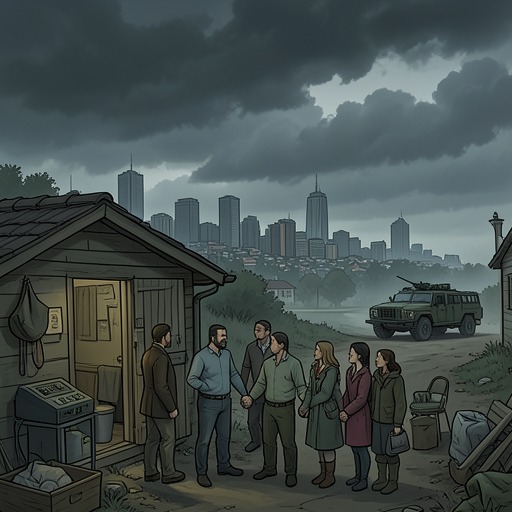
The Home as a Refuge in Turbulent Times
The Museum of InnocenceThe Keskin family home in Çukurcuma is both a refuge from Istanbul’s political turmoil and the intimate setting in which Kemal sustains his attachment to Füsun. For seven years and ten months, he returns for supper, becoming part of a household routine that offers continuity while bombs, armed clashes, coups, and curfews unsettle the streets outside. The home cannot keep history out: its television brings the news indoors, and military restrictions eventually determine when Kemal must leave. Its refuge lies instead in the ordinary life the family maintains, and in the repeated acts through which Kemal belongs there as a guest who is expected, though his deeper reason for coming remains unspoken.
A refuge made by repeated visits
Kemal’s visits acquire their force through repetition. Between October 23, 1976, and August 26, 1984, he goes to the Keskin home 1,593 times over 409 weeks. The average is about four suppers a week, though the actual rhythm varies: some weeks he sees the family every day; in others, indignation and his attempts to forget Füsun keep him away. He never stays away for more than ten days, because longer absences bring back the misery he experienced in autumn 1975. The family, meanwhile, comes to expect him and keeps a place for him at the table without needing to issue a formal invitation.
This welcome gives the house a dependable shape, but it also makes Kemal acutely aware of his uncertain status. When he hesitates to visit, he worries that another evening at the table might impose on the family; staying away, however, means missing Füsun and risking that his absence will be taken amiss. The shared term for his visits is simply sitting, a euphemism that lets everyone avoid naming the private attachment that brings him there. The domestic routine therefore shelters an unspoken feeling as well as a visitor: he can be close to Füsun within the family’s company, even when they rarely find themselves alone and cannot openly define their relationship.
Domestic time and its rituals
The household’s sense of time is divided between the outside world’s public schedule and a more intimate rhythm. A German-made wooden wall clock, with a glass case, pendulum, and chime, hangs beside the door. It stands as a reminder of time’s continuity and of the modern world beyond the house, although television has largely displaced its practical role. The clock’s presence offers a quiet counterpoint to change: it continues to tick and chime even when no one in the sitting room or bedrooms can hear it, and the family still winds it. On nights when Kemal wakes after drinking and hears its chime from the corridor, the sound brings him comfort.
In practice, television regulates the family’s evenings. It is usually on, and at seven o’clock Füsun checks her wristwatch against the large clock shown on screen before TRT’s news begins. Tarık Bey checks one of his pocket watches as well. Kemal watches Füsun carefully as she concentrates on setting her watch; she knows he enjoys the small ritual, and her smile when she gets the time right turns a public broadcast into a private exchange between them. The family’s evening is measured less by clocks than by programs and their endings. Kemal estimates that he usually arrives around seven and leaves soon after the nightly closing ceremony around midnight, spending roughly five hours at each visit.
The pattern makes ordinary time feel temporarily suspended. Kemal describes the peace of watching television with the family and his attachment to the house, its building, and the people in it as part of what allows him to return faithfully. His attention gradually extends beyond Füsun to the world connected with her: family habits, objects, silences, and shared evenings. The refuge is thus not an escape into solitude. It is produced by sitting together, watching, eating, and returning to familiar gestures until a long span of years can be experienced as a succession of recognizable evenings.
Political violence at the threshold
The contrast between domestic calm and danger outside becomes sharper from 1978, when bombs go off at night even in the neighborhood. Streets toward Tophane and Karaköy are controlled by nationalist factions, while the crooked streets toward Cihangir are associated with workers, students, and petty bureaucrats sympathetic to Kurdish, Alevi, and left-wing causes. Militants from opposing sides sometimes fight for control of streets, coffeehouses, and small squares; bombings can lead to further armed clashes. Çetin Efendi, who drives Kemal, is often caught in the crossfire and worries about where to park or wait. He refuses Kemal’s suggestion that he go to the Keskin home alone.
As Kemal leaves the house, the streets of Çukurcuma, Tophane, and Cihangir are unsafe. Posters, notices, and slogans appear on walls, and Kemal and Çetin exchange fearful looks in the car’s mirror. The family’s relief at being safe at home is therefore not an abstract comfort: it is set against a route through a city where even the driver’s movements involve risk. Yet the refuge remains permeable. The evening news reports bombings, killings, and massacres, making the violence present at the supper table. The family generally avoids discussing those reports, turning instead to the television host or other subjects. Domestic peace depends partly on this shared redirection of attention, not on any belief that the danger has disappeared.
The television screen can also help restore the room’s quiet. When Füsun switches it off, the broadcast and its people vanish from view, and Tarık Bey’s relief at putting them behind the family reinforces Kemal’s feeling that what matters is remaining with the household. But the news is a recurring breach in that calm: it interrupts the sense of being outside time with accounts of the country sliding toward civil war. The house can soften the impact of public events, not erase them.
Coup, curfew, and the limits of shelter
The 1980 Turkish Coup changes the terms of Kemal’s visits. In September 1980, martial law brings a ten o’clock curfew. He must leave at about a quarter to ten, well before he feels he has spent enough time with Füsun. During the final minutes, Çetin drives him through dark streets that are emptying quickly. Kemal experiences the hurried departure as a fresh deprivation: the state’s timetable cuts into the private routine that had given him comfort.
The coup also enters the household through television. The generals denounce politicians and dissident intellectuals and lecture the nation about its conduct. Reports of arrests, executions, and other punishments reach the Keskin supper table, where they leave the family silent. At such moments Kemal feels closer to Füsun and to the family, as though their shared response makes him part of the household. At the same time, the political order reaches into everyday life: the Pelür Bar is emptied, and Kemal resolves to drink less, reduce the disgrace associated with his love, and restrain his collecting. Less than two months after the coup, he begins arriving earlier so he can see more of Füsun before the curfew takes him away.
A small object on the television embodies the family’s wish for protection. After a dog figurine belonging to the household breaks, Kemal brings a replacement with black ears. Nesibe the seamstress places it on the set. The dogs gathered there, she believes, bring peace; their presence makes the room seem guarded while gunfire echoes in the neighborhood and the outside world grows more surreal. The figurine does not stop the violence, but it gives the family a domestic image of watchfulness and shelter. Alongside the wall clock, the television, and the supper table, it turns an ordinary room into a place where people can briefly feel protected.
Narrative significance
The home’s refuge is made of rhythms as much as walls: supper, television, watch-setting, conversation, silence, and Kemal’s return. A long passage of recollection dwells on small variations within these evenings—rain at the windows, a car passing, a distant explosion, someone tending the stove, or Füsun’s hand at the table. Such details place political instability beside domestic repetition without making either disappear. The outside world can intrude as a broadcast or a sound from the street; the family’s habitual life gives those intrusions a frame in which they can be endured.
For Kemal, the house’s protective quality is inseparable from his love for Füsun, but it gradually exceeds the pursuit of private moments with her. His attachment reaches the family, the building, and the objects associated with their shared time. The refuge is therefore both a social space and a remembered one: its recurring evenings preserve a sense of closeness even as curfews, danger, and the passing years limit what can happen there. The home offers no permanent immunity from history. It offers a place at the table, a familiar evening, and a temporary calm that becomes more precious because the world beyond it remains unsettled.